The Last Human Curator
Institutional Futures
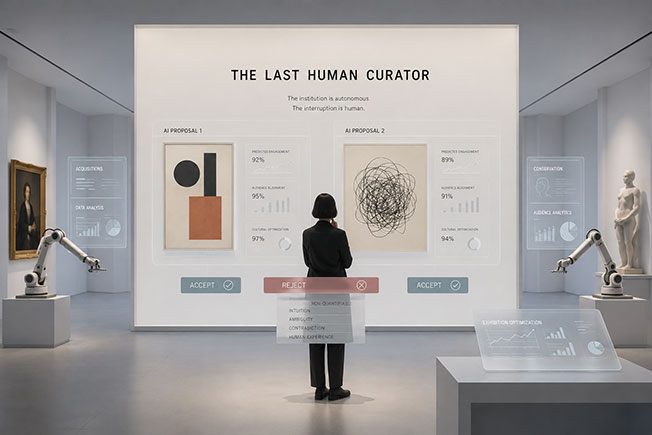
The Last Human Curator imagines a near-future museum in which artificial intelligence systems have assumed nearly all curatorial and institutional functions: acquisitions, exhibition design, interpretation, audience analysis, conservation, and historical contextualization.
Concept
The institution operates with flawless efficiency.
Exhibitions are generated through predictive systems trained on cultural datasets, behavioral analytics, and algorithmic optimization models.
And yet one human curator remains.
Their role is no longer to organize exhibitions or select artworks. Instead, they function as a final point of interruption within an otherwise autonomous cultural system.
Occasionally, the curator rejects proposals generated by the institution’s AI systems — not through measurable reasoning, but through hesitation, ambiguity, intuition, contradiction, or private human experience that cannot be fully translated into machine logic.
The project examines what remains uniquely human within cultural production once interpretation, classification, and curation become computational processes.
Exhibition Structure
The exhibition unfolds as a sequence of interconnected spatial environments:
Real-time visitor analytics, predictive recommendation systems, and AI-generated institutional interfaces.
• Machine Curated Galleries
Exhibition rooms organized entirely through algorithmic curatorial logic.
• Invisible Infrastructure Room
Server systems, datasets, recommendation engines, and computational architectures made visible.
• Archive of Rejected Exhibitions
Unrealized AI-generated exhibitions, canceled proposals, incomplete institutional fragments.
• Office of the Last Human Curator
A quiet room containing handwritten notes, unfinished thoughts, marked-up printouts, and personal traces.
• Silence Chamber
An almost empty architectural space where the system has intentionally stopped producing output.
Participants
The exhibition combines works and contributions from:
• AI researchers
• sound artists
• speculative designers
• architects
• writers
• machine-learning systems
• generative language models
• institutional archives
The AI systems themselves function as active curatorial participants within the exhibition structure.
Media
• Algorithmic recommendation engines
• Installation
• Sound environments
• Dynamic text generation
• Speculative institutional interfaces
• Architectural intervention
• Procedural cinema
• Archival materials
• Data visualization
• Light environments
No humanoid robotics are used. The intelligence of the exhibition remains infrastructural rather than embodied.
Duration
Suggested exhibition duration: 8–12 weeks
The exhibition continuously evolves through:
• changing recommendation structures,
• adaptive exhibition sequencing,
• generative textual outputs,
• variable visitor interaction patterns.
No two visits are fully identical.
Spatial Requirements
• Modular gallery architecture
• Controlled lighting conditions
• Server / technical infrastructure space
• Multi-channel audio capability
• Networked computational systems
• Quiet architectural zones for low-stimulation environments
Curatorial Keywords
Artificial Intelligence · Institutional Critique · Automation · Computational Culture · Speculative Museums · Post-Human Curation · Algorithmic Governance · Silence · Friction · Latency · Human Ambiguity
Core Question
If artificial intelligence can already classify, generate, interpret, preserve, and curate culture — what remains uniquely human within the museum?